When you are trying to conceive, it can quickly feel as though everyone has an opinion, but very few people can clearly explain what actually matters.
You might be told to “just keep trying,” while at the same time being flooded with advice about supplements, hormones, IVF timelines, acupuncture, inflammation, sperm health, and countless fertility tests. For many people, the challenge is not a lack of information. It is the lack of clear, joined-up guidance.
That’s exactly why I recently hosted The Fertility Masterclass with Dr Sunila Prasad.
The goal of this session was not to add more noise to the fertility space, but to provide grounded, medically informed insight into how fertility actually works in practice, including how the healthcare system approaches fertility investigations, where lifestyle and holistic support may fit in, and how people trying to conceive can better advocate for themselves along the way.
This article shares some of the key themes from that conversation.
Meet the Experts Behind the Masterclass
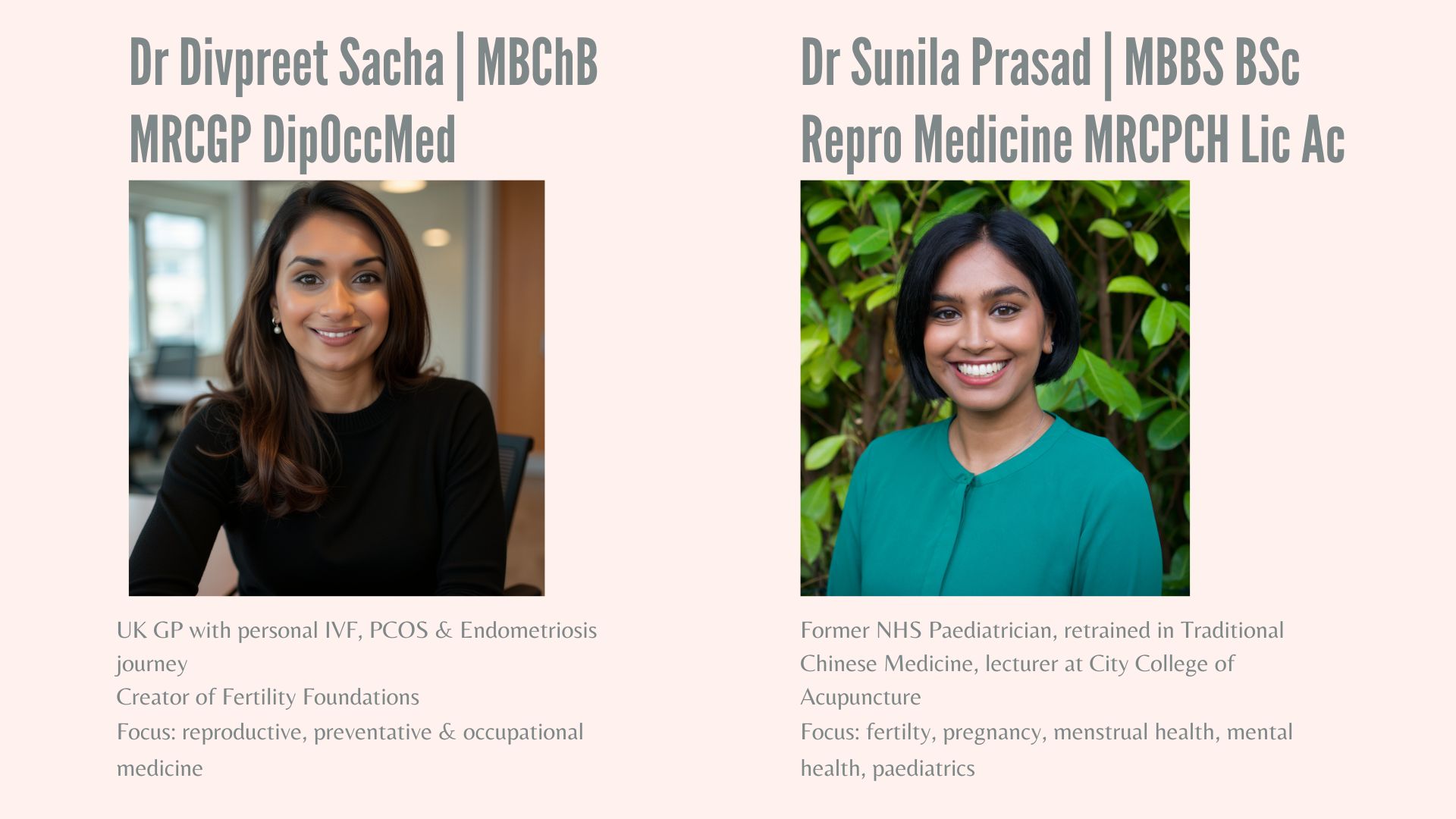
I’m Dr Divpreet Sacha, a UK GP with a special interest in women’s health and fertility education. My work focuses on translating complex fertility information into clear, evidence-based guidance for people navigating the journey to conception.
For this masterclass, I was joined by Dr Sunila Prasad, a medical doctor and licensed acupuncturist specialising in fertility and women’s health. She previously worked as an NHS paediatric doctor before undertaking further training in Traditional Chinese Medicine acupuncture. She also holds a first-class degree in Reproductive Medicine from Imperial College London, bringing a strong academic and clinical perspective to her integrative approach.
Together, we wanted to explore fertility from both a medical and holistic lens, not as competing viewpoints, but as complementary ways of supporting people through what can be a very complex and emotional journey.
Why Fertility Can Feel So Confusing
One of the biggest frustrations for people trying to conceive is how fragmented fertility care can feel.
There are multiple guideline bodies involved in reproductive health, including organisations such as NICE in the UK, the World Health Organization, and various European and American fertility societies. While all aim to support evidence-based care, their recommendations can differ.
At the same time, access to investigations and treatment within healthcare systems can vary depending on:
- local funding policies
- regional referral criteria
- waiting times
- individual GP or specialist interpretation of guidelines
As a result, two people in different regions may experience very different fertility pathways, even when their situations appear similar.
Understanding that the system can be complex, rather than assuming something has gone wrong personally, can often help reduce unnecessary stress and confusion.
Fertility Investigations: What Actually Matters
When fertility investigations begin, it is natural to want as many tests as possible. However, in clinical practice the most important thing is not simply the number of tests performed, it is whether the right investigations are done at the right time.
Several key areas are commonly assessed when someone is struggling to conceive.
Hormonal Assessment
Hormone testing is usually performed at specific points in the menstrual cycle to give accurate information about ovarian function and ovulation.
For example:
- early-cycle hormone testing can provide insight into ovarian function
- progesterone testing after ovulation helps confirm whether ovulation is occurring
- thyroid function can influence menstrual cycles and fertility outcomes
The timing of these tests is crucial, as interpreting results without considering cycle phase can lead to misleading conclusions.
Ovarian Reserve
Anti-Müllerian hormone (AMH) testing is often used to estimate ovarian reserve. However, it is important to understand what this test can and cannot tell us.
AMH can be useful for predicting how someone may respond to fertility treatment such as IVF, but it does not predict the likelihood of natural conception and should always be interpreted in clinical context.
Male Fertility
Male factor fertility is sometimes under-investigated, despite contributing to a significant proportion of fertility challenges.
Semen analysis remains a key investigation, and in certain situations additional assessments, such as sperm DNA fragmentation testing, may provide further insight.
Addressing lifestyle factors such as smoking, alcohol intake, weight, sleep, and environmental exposures can also play a meaningful role in supporting sperm health.
The Role of Lifestyle and Holistic Support
Fertility care is often viewed purely through a medical lens, blood tests, scans, medications, and treatment pathways. However, reproductive health is influenced by many aspects of overall wellbeing.
During the masterclass, we discussed how lifestyle and environmental factors can interact with reproductive health, including areas such as:
- nutrition and inflammation
- sleep quality
- stress and nervous system regulation
- exposure to endocrine-disrupting chemicals
- emotional wellbeing
It is important to approach this topic with balance.
Lifestyle changes are not a guarantee of pregnancy, and fertility struggles are never simply the result of someone not being “healthy enough.” However, supportive changes can help optimise overall health and may contribute positively to reproductive outcomes.
For many people, focusing on realistic, sustainable improvements, rather than extreme restrictions or pressure to be perfect, is a far healthier and more sustainable approach.
Complementary Therapies in Fertility Support
Another topic explored in the masterclass was the potential role of complementary therapies such as acupuncture.
Research into acupuncture and fertility is still evolving, but some studies suggest that it may support reproductive health through mechanisms such as:
- improving blood flow to reproductive organs
- influencing hormonal signalling pathways
- supporting nervous system regulation
- reducing stress and anxiety
In practice, many people find these therapies helpful not only for physical support but also for emotional wellbeing during fertility treatment.
However, it is important that complementary therapies are viewed as supportive tools, rather than replacements for appropriate medical care.
Working with qualified practitioners and maintaining open communication with your medical team is essential when integrating different approaches.
The Importance of Self-Advocacy in Fertility Care
One of the most powerful themes from the masterclass was the importance of informed self-advocacy.
Many people feel hesitant to ask questions during medical appointments, but understanding your fertility pathway can help you navigate the system more effectively.
Some useful questions to consider asking include:
- What is my local referral pathway for fertility care?
- Which investigations are appropriate in my situation?
- Are my tests being interpreted within the correct cycle context?
- Has male factor fertility been fully assessed?
- What evidence supports the treatments being recommended?
Being informed does not mean challenging medical professionals unnecessarily. Instead, it allows you to participate more actively in decisions about your own care.
Fertility Is More Than a Medical Process
While fertility medicine focuses on biological processes, the experience of trying to conceive often affects many areas of life.
Relationships, emotional wellbeing, identity, and future plans can all become intertwined with the fertility journey. For this reason, compassionate support and clear information are just as important as clinical expertise.
Our aim with the masterclass was to create a conversation that felt balanced, evidence-based, and genuinely supportive for people navigating this complex process.
Watch the Full Fertility Masterclass
This article provides a high-level overview of some of the themes we discussed.
In the full Fertility Masterclass, Dr Sunila Prasad and I explore these topics in much greater depth, including:
- how fertility pathways work in practice
- which investigations are most important to understand
- how lifestyle and holistic approaches may support fertility
- common misconceptions people encounter during their journey
- practical ways to advocate for yourself within the healthcare system
If you would like to watch the full session, the on-demand replay is now available.
You can access the complete masterclass here:
https://herholistichealthuk.systeme.io/masterclassreplay
Final Thoughts
Fertility journeys are rarely straightforward, and navigating the medical system alongside emotional and lifestyle factors can feel overwhelming.
But clearer information, better questions, and supportive guidance can make the process far easier to understand.
Whether you are just beginning to explore fertility support or already navigating investigations and treatment, taking the time to understand the bigger picture can help you move forward with greater confidence and clarity.